Nudge: The Final Edition: Audio Summary and Analysis
Welcome to today's Deep Dive, where we explore the ideas in Nudge: The Final Edition by behavioral economists Richard Thaler and Cass Sunstein. Imagine a school system where simply moving fruit to eye level and desserts to a less convenient line changes what thousands of kids choose to eat, without banning anything. That is a nudge: any aspect of the environment that alters behavior predictably, without forbidding options or changing economic incentives. Today we unpack libertarian paternalism, the myth of the perfectly rational e-con, and the two systems of thinking mapped by Daniel Kahneman.
Nudges Shape Everyday Choices
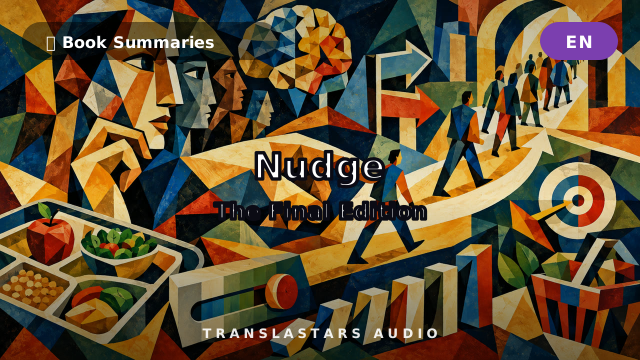
A nudge is any aspect of the environment that predictably alters behavior without forbidding options or changing economic incentives. Consider Carolyn, who runs a huge city school system with hundreds of cafeterias. She changed nothing about the menus. She did not ban French fries or cookies. She simply rearranged how food was displayed, placing fresh fruit at eye level and moving sugary desserts to a less convenient line. The result was staggering: kids ate more healthy food and less junk, purely because the physical environment changed. Thaler and Sunstein call this subtle steering a nudge. It preserves freedom, since you can still choose the chocolate cake, and it costs nothing extra. Yet it is paternalistic, because the choice architect deliberately designs the environment to steer people toward options that improve their own lives, as judged by those people themselves. There is no neutral design, since the food must go somewhere. So why not arrange it to benefit the eater? This shows we are not the hyper-rational e-cons of traditional economics, but humans deeply shaped by context. Understanding this lets us design environments that make good choices easy.
Libertarian Paternalism Preserves Freedom
Libertarian paternalism sounds like a contradiction, but it is not. It is libertarian because it fully preserves your freedom. You can still choose the chocolate cake; no option is forbidden. It is paternalistic because a choice architect deliberately designs the environment to steer you toward choices that improve your life, as judged by you. This approach requires no extra cost. It simply recognizes that there is no neutral design. The food must go somewhere, so why not place it where it helps? In Carolyn's cafeterias, moving fruit to eye level and desserts to a less convenient line increased healthy eating without banning anything. This is a nudge: any aspect of the environment that alters behavior predictably without forbidding options or significantly changing economic incentives. Nudges work because we are not e-cons, perfectly rational beings. We are humans influenced by context. By understanding this, we can design environments that make good choices easy while still letting people choose freely. Libertarian paternalism thus offers a way to improve decisions without restricting liberty or imposing costs.
Humans Are Not E-Cons
Traditional economics assumed we are e-cons: mythical, perfectly rational beings who calculate probabilities like Einstein, remember like a supercomputer, and possess Gandhi's willpower. An e-con would walk into Carolyn's cafeteria, assess every item's nutritional value, and make the mathematically optimal choice, regardless of where the apple sat. But no real person lives that way. Real people forget the trash, fumble a 20 percent tip, and hit snooze instead of running three miles. We are profoundly shaped by context, even sensory context. Consider the Shepard tables illusion: two drawn tables look completely different in shape, yet measure identically. Our eyes simply deceive us. Kahneman mapped two thinking systems: the fast, effortless, emotional automatic system, compared to Homer Simpson, and the slow, deliberate reflective system, compared to Mr. Spock. The bat and ball problem proves it. A bat and ball cost one dollar and ten cents; the bat costs a dollar more. Your brain screams ten cents, but the answer is five cents. Cognitive strain makes us default to whatever feels easiest, so we rely on heuristics, mental shortcuts that create predictable traps.
Automatic and Reflective Systems
To understand why nudges work, Thaler and Sunstein draw on the psychologist Daniel Kahneman, who mapped two distinct systems of thinking in our brains. The automatic system is fast, effortless, intuitive, and deeply emotional. It is your lizard brain, compared to Homer Simpson, the ultimate automatic thinker. The reflective system is slow, deliberate, and calculating, requiring immense cognitive bandwidth. That one is Mr. Spock. We let Homer Simpson drive the bus most of the time because Mr. Spock is lazy. Kahneman's bat and ball problem tests this. A bat and ball cost a dollar and ten cents, and the bat costs one dollar more than the ball. Your automatic system screams ten cents, but the real answer is five cents. The mechanism is cognitive strain. Our brains consume massive physical energy, so to conserve calories, evolution designed us to rely on the automatic system whenever possible. We default to whatever feels easiest. Because these shortcuts bypass our inner Mr. Spock, they create predictable traps, which is exactly why deliberate choice architecture matters so much.
Heuristics Create Predictable Traps
Mental shortcuts, called heuristics, let us navigate a complex world without running a full cost benefit analysis every time. But because they bypass the reflective system, they create predictable traps. Anchoring is one: your brain latches onto the first number it sees and treats it as a baseline. Tipping screens in taxis and coffee shops exploit this. When the default options read 15, 20, or 25 percent, the anchor shifts upward, and 15 percent suddenly feels cheap even if you planned to tip less. Push the anchor to an absurd extreme, though, and the illusion breaks. Reactance kicks in, the reflective system notices the manipulation, and some customers leave zero to reassert autonomy. Companies also exploit the availability heuristic by selling useless warranties, and status quo bias through dark patterns, interfaces engineered to make cancellation nearly impossible. They use our automatic brains to pick our pockets. That is why transparent choice architecture matters. We cannot rely on markets to protect us; we must design defaults and regulations that shield humans from those who would weaponize our predictable irrationality.
- A nudge alters behavior predictably without forbidding options or changing incentives.
- Libertarian paternalism steers people toward better choices while fully preserving their liberty.
- Real humans are not perfectly rational e-cons and are shaped by context.
- Kahneman's automatic and reflective systems explain our fast intuition and slow calculation.
- Heuristics like anchoring and status quo bias create predictable traps for decision making.
- Dark patterns exploit our predictable irrationality, so ask who designed your environment.
A nudge is any aspect of the choice architecture that alters people's behavior in a predictable way without forbidding any options.
Why do we keep choosing the cake over the apple, even when we know better? This audio summary of Nudge by Richard Thaler and Cass Sunstein reveals how small cha
▶ Listen to the summaryKeep learning, 15 minutes a day
TranslaStars Audio turns the best books, courses and podcasts into audio summaries you can listen to anywhere. Add it to your home screen and build a daily learning habit.
Open TranslaStars Audio